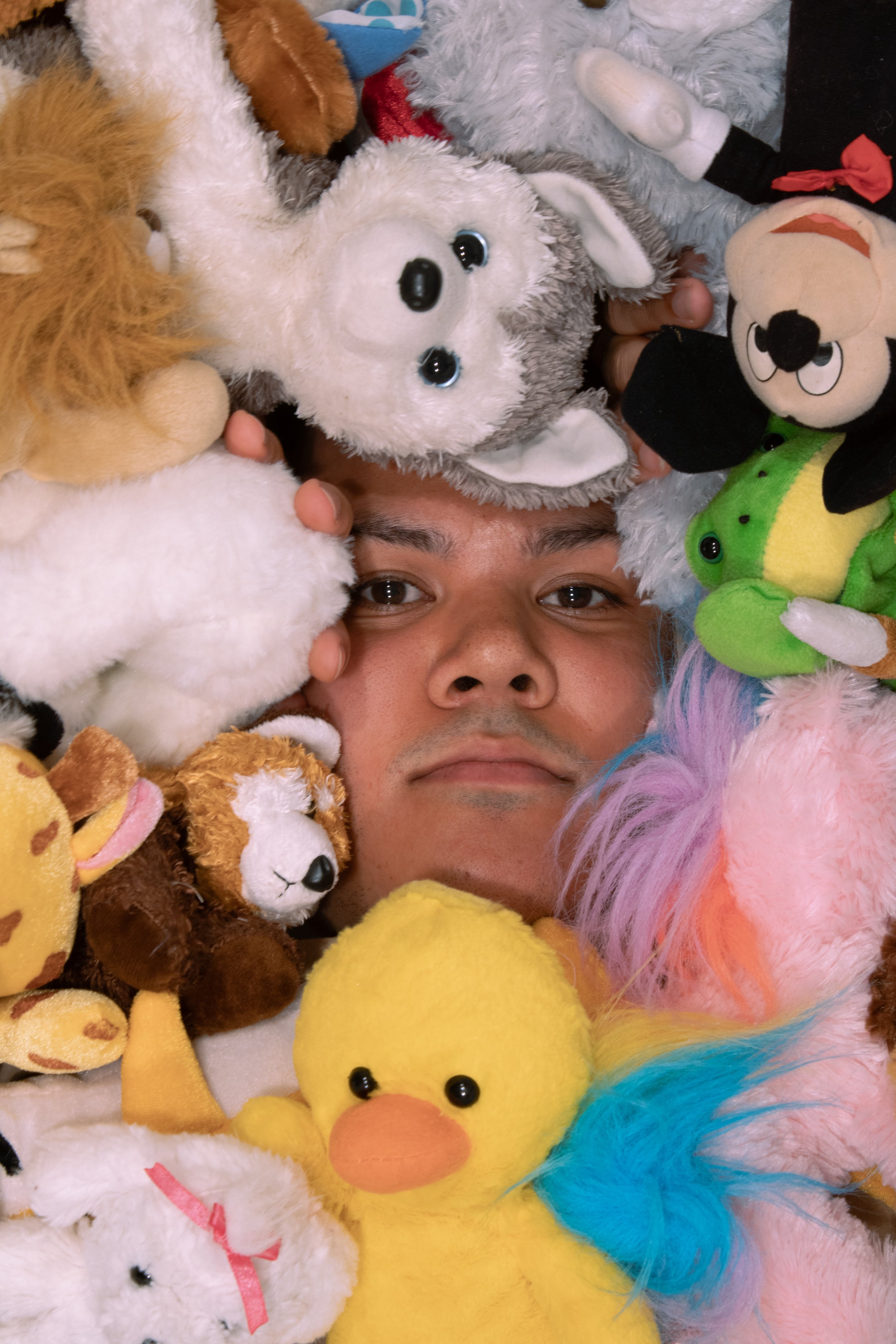
In documenting these moments, I’m able to peel back the rugged outer shell layered on by American Imperialism, to reveal the intimate moments that people experience when they leave their ancestral home. In doing so I hope to present a different kind of Latine Americano. One that is resilient, but also vulnerable. Able to share in their experiences navigating their environment. While assimilation means death, change and understanding doesn’t. In choosing to Identify as Latine, I combine the information from my ancestry and accept my identity as Queer and Non-Binary, while choosing to denounce the culture of machismo that dominates Latino America. From my mother, I learned how to sew at a young age, and from my father I learned construction. These skills influence my art making. By connecting these current processes to the skills taught to me by my parents, I explore what it means to inherit generational and ancestral knowledge. I use these as a means of survival. This body of work brings awareness to the things I learned from my parents as well as things that seamlessly skipped a generation due to the effects of migration. In creating work that’s so intimate and personal, I invite the user into my space with the intention of gaining an understanding.
Artist Statement
I explore belonging. The feelings of not enough are what drive my urge to learn more about the things that were temporarily lost when my parents emigrated to the United States from Costa Rica. In attempting to reconnect, I find myself watching as the gap widens, showing me just how different I am. Looking back at my own experiences growing up, to assimilate is to die, and with my parents wanting more for my sister and I, they didn’t realize the price we would pay in order for those opportunities to come true. As someone raised in institutions that were predominantly white, thoughts of not belonging originated from a lack of representation and diversity. But it doesn’t end there. With so many cultures, vastly different from one another, forming what is today Latin America, it made sense why a Costa Rican living in North Carolina would feel like an outsider to a community where the majority of the Latines were Mexican. This lack of belonging was met with a culture that encouraged machismo and discouraged any exploration of gender identity. That separation birthed envy. Whether it was my sister’s white skin, or being called gringo in my ancestral home, a resentment was born further driving feelings of not enough.
I make work about this. In returning to my ancestral home of Costa Rica more frequently, I’ve used documentation to recognize and record my experiences as second generation. In my work, I seek to reconnect. I yearn to reconnect. Not only to the home I grew up in, in North Carolina, but to the one my parents left. Through reimagined histories, I reminisce on memories from the past and create desired timelines that are in conversation with harsh realities. In a similar sense to how some children dress as their heroes, I construct costumes that represent family members, the cattle they worked with, and the roles they once held. With a familial history rooted in Ranching in Costa Rica, I craft soft sculptures of tools as well as the livestock that my ancestors worked alongside. If I’m not able to become what they are and once were, at least in appearance, I can feel like I belong. These soft works also offer the viewer insight on place. A glimpse into desires of futurity and survival, and a continued lineage rooted in an agrarian lifestyle. This recreation of narrative grants the viewer a temporary residency, allowing them a glimpse into the lives of the Latine Americano.